




Call Us On
0086 13805968557
Address
Xilin Industrial District, Honglai Town, Quanzhou Nan 'an City, China


Apr 7,2026
The global baby diaper market represents one of the most stable and recurring demand-driven industries within the broader hygiene and personal care sector. Unlike discretionary consumer goods, baby diapers are essential, non-cyclical products that generate continuous purchasing behavior, making the market highly resilient even during economic downturns.
Over the past decade, the industry has undergone a transformation fueled by demographic expansion, urbanization, product innovation, and digital retail evolution. While historically driven by population growth, the modern diaper market is increasingly influenced by premiumization, sustainability concerns, and convenience-based consumption patterns.
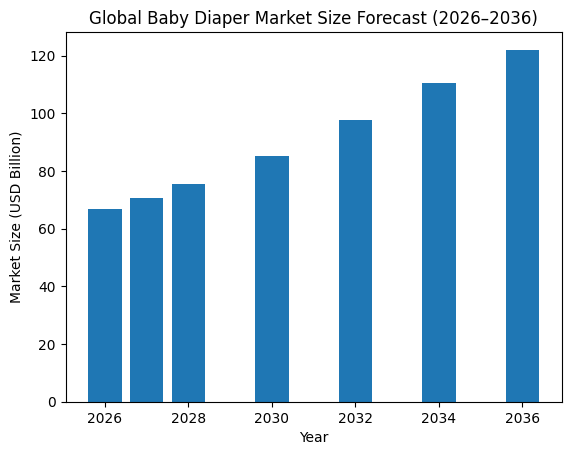
As of 2026, the global baby diaper market is valued at approximately USD 66.9 billion, with projections indicating growth to USD 122.1 billion by 2036, reflecting a compound annual growth rate (CAGR) of around 6.2%.
Global Market Size & Long-Term Forecast
The projected expansion of the baby diaper market highlights a combination of volume growth in emerging economies and value growth in developed regions.
Table 1: Global Baby Diaper Market Forecast (2026–2036)
|
Year |
Market Size (USD Billion) |
Key Growth Phase |
|
2026 |
66.9 |
Baseline |
|
2027 |
70.8 |
Early Expansion |
|
2028 |
75.5 |
Demand Acceleration |
|
2030 |
85.2 |
Market Consolidation |
|
2032 |
97.8 |
Premium Growth Phase |
|
2034 |
110.5 |
Advanced Market Maturity |
|
2036 |
122.1 |
Stabilized Expansion |
Key Interpretation
Core Market Drivers: What Is Fueling Growth?
1. Demographic Expansion in Emerging Markets
Population growth remains the primary structural driver of diaper demand. Regions such as South Asia, Africa, and parts of Southeast Asia continue to report high birth rates, contributing to consistent demand expansion.
2. Urbanization and Changing Lifestyles
Urban living significantly impacts diaper usage patterns:
Urban households prioritize convenience, hygiene, and time-saving solutions, directly boosting disposable diaper penetration.
3. Rising Disposable Income and Middle-Class Expansion
Economic growth in developing countries has led to:
This shift is especially visible in tier-2 and tier-3 cities where modern retail infrastructure is expanding.
4. Increasing Health & Hygiene Awareness
Modern parents are more informed about:
This awareness is pushing manufacturers to invest in advanced product features, contributing to higher average selling prices.
Market Segmentation: Detailed Breakdown
By Product Type
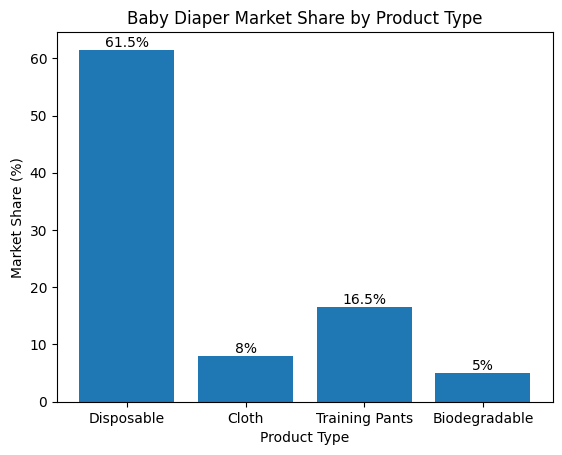
The baby diaper market is segmented into disposable, cloth, training, and biodegradable categories.
Table 2: Product Type Segmentation
|
Product Type |
Market Share (%) |
Growth Trend |
Key Characteristics |
|
Disposable Diapers |
61–62% |
Stable |
High convenience, dominant segment |
|
Cloth Diapers |
<10% |
Fast Growing |
Reusable, cost-efficient |
|
Training Pants |
15–18% |
Moderate |
Designed for toddlers |
|
Biodegradable Diapers |
Emerging |
High Growth |
Eco-friendly materials |
Analysis
By Age Group
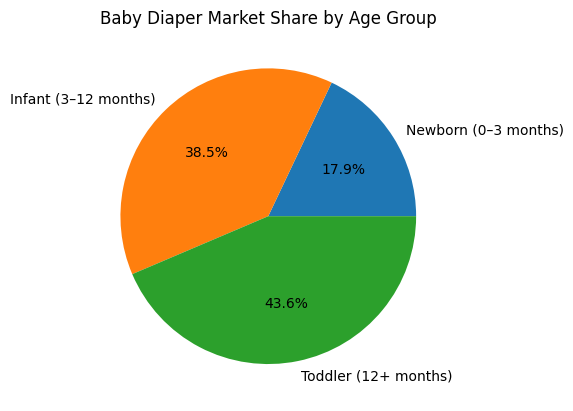
Table 3: Age-Based Segmentation
|
Age Group |
Market Share (%) |
Demand Drivers |
|
Newborn (0–3 months) |
15–20% |
High sensitivity needs |
|
Infant (3–12 months) |
35–40% |
Frequent diaper changes |
|
Toddler (12+ months) |
40–45% |
Mobility and training |
Analysis
By Distribution Channel
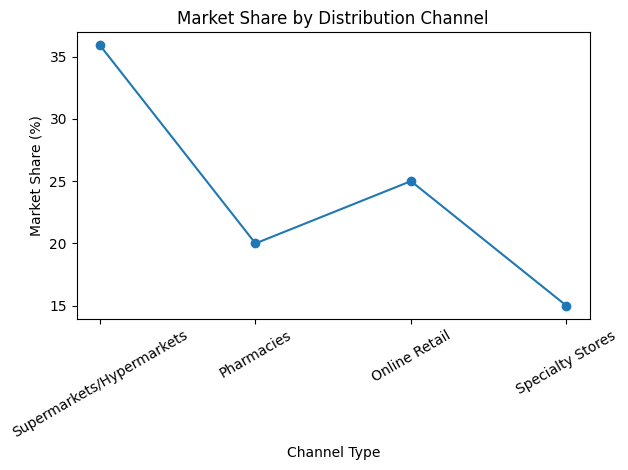
Table 4: Distribution Channels
|
Channel Type |
Market Share (%) |
Growth Outlook |
|
Supermarkets/Hypermarkets |
~35.9% |
Dominant |
|
Pharmacies |
Moderate |
Stable |
|
Online Retail |
Fastest Growing |
High CAGR |
|
Specialty Stores |
Niche |
Moderate |
Analysis
Regional Market Analysis
Table 5: Regional Market Share & Growth
|
Region |
Market Share (%) |
Growth Rate |
Market Characteristics |
|
Asia-Pacific |
35–36% |
High |
Large population, rising adoption |
|
North America |
25–26% |
Moderate |
Mature, premium-focused |
|
Europe |
20–22% |
Stable |
Eco-driven demand |
|
Latin America |
8–10% |
Emerging |
Urban growth |
|
Middle East & Africa |
<10% |
High Potential |
Untapped markets |
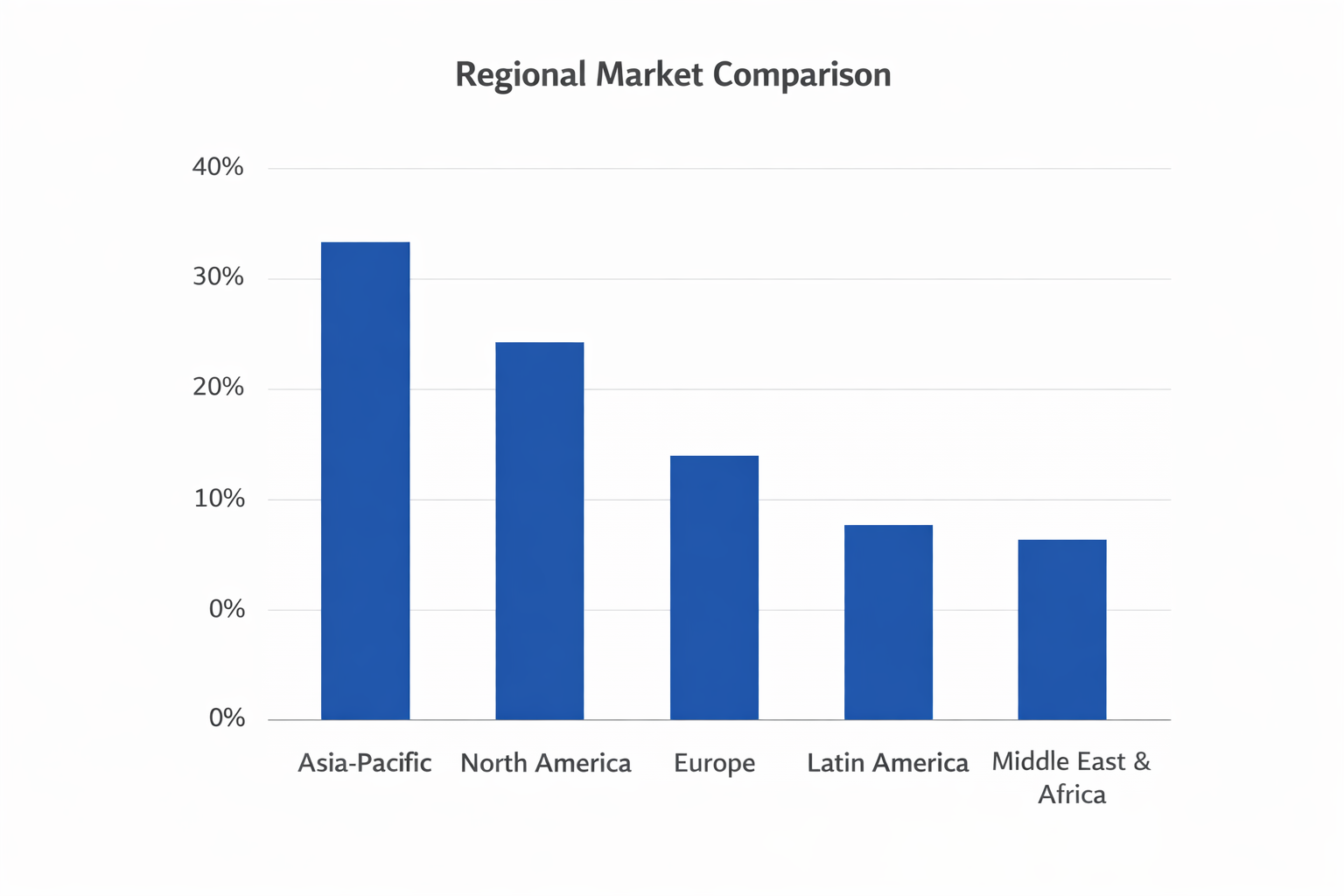
Asia-Pacific: Growth Engine of the Market
Despite strong growth, rural areas still show partial reliance on traditional alternatives, indicating future growth potential.
North America & Europe: Mature but Profitable Markets
These regions are characterized by:
Growth here is driven more by value innovation than volume expansion.
Emerging Markets: Untapped Opportunities
Latin America, the Middle East, and Africa offer:
These regions represent long-term growth opportunities for manufacturers.
Competitive Landscape: Market Structure
The industry is characterized by a mix of large-scale manufacturers and regional players.
Table 6: Market Structure
|
Category |
Market Share (%) |
|
Leading Manufacturers |
55–60% |
|
Private Labels |
Up to 20% |
|
Regional Players |
20–25% |
Analysis
Industry Trends & Innovation
1. Sustainability & Eco-Friendly Products
Environmental concerns are reshaping product development:
Table 7: Sustainability Impact
|
Factor |
Impact Level |
|
Consumer Demand |
High |
|
Regulatory Pressure |
Increasing |
|
Innovation Investment |
High |
2. Smart Diaper Technology
Emerging innovations include:
Though niche, this segment represents future premium market potential.
3. Direct-to-Consumer (D2C) Growth
The rise of digital commerce has introduced:
Environmental & Regulatory Considerations
Disposable diapers present significant environmental challenges due to:
Table 8: Environmental Factors
|
Factor |
Impact |
|
Waste Generation |
High |
|
Recycling Infrastructure |
Limited |
|
Regulatory Pressure |
Increasing |
Governments and organizations are encouraging:
Market Challenges
1. Affordability Constraints
2. Raw Material Price Volatility
3. Market Saturation
4. Supply Chain Risks
Future Outlook: What Lies Ahead?
The baby diaper market is expected to remain robust and steadily expanding over the next decade.
Table 9: Future Growth Drivers
|
Growth Driver |
Impact Level |
|
Emerging Market Demand |
Very High |
|
Premiumization |
High |
|
Sustainability Trends |
High |
|
E-commerce Expansion |
High |
Key Forecast Insights
Conclusion
The global baby diaper market stands as a high-growth, resilient, and evolving industry driven by demographic consistency and changing consumer expectations. While traditional disposable diapers continue to dominate, the future of the market lies in innovation, sustainability, and digital transformation.
Emerging economies will remain the backbone of volume growth, while developed regions will drive premium and eco-friendly product demand. Despite challenges such as cost pressures and environmental concerns, the industry is well-positioned for long-term expansion.
As the market moves toward 2036, companies that can balance affordability, innovation, and sustainability will be best positioned to capture the next wave of growth.


Xilin Industrial District, Honglai Town, Quanzhou Nan 'an City, China